The mitigation of aircraft explosion hazards requires the investigation of the autoignition of aviation hydraulic fluid. Tributyl phosphate (TBP), a phosphate ester, is the primary component of aviation hydraulic fluid. The nature of phosphate ester autoignition is difficult to predict, as the phosphate component exhibits fire-resistant properties and the hydrocarbon component is highly flammable. The ASTM E659 experimental test method was conducted on a range of temperatures and fluid concentrations to characterize the autoignition of aviation hydraulic fluids—Skydrol PE-5 and Skydrol LD-4—by observing the temperature change and luminosity. Analysis of the Skydrol PE-5 ASTM E659 ignition data demonstrates how richer mixtures can generate ignition significantly below the reported autoignition temperature. Additionally, computational modeling of idealized TBP combustion was carried out through MATLAB and Cantera to identify its primary products. This analysis predicted that at stoichiometric conditions, the maximum production of metaphosphoric acid occurs. The results of this investigation can be applied to aviation safety efforts and aid in mitigating potential aircraft fire hazards.
Author: Juan Luchsinger
California Institute of Technology
Mentors: Professor Joseph Shepherd and Conor Martin
California Institute of Technology
Editor: Adele Basturk
Introduction
The Explosion Dynamics Laboratory (EDL) at Caltech carries out experiments in the low-temperature autoignition of aviation kerosene and surrogates, using the ASTM-E659 standardized test method for determining the autoignition temperature (AIT) of chemicals [1]. A similar investigation into phosphate ester-based aircraft hydraulic fluids could provide insight into how the temperature and the fluid’s concentration can impact its AIT and ignition behavior.
Analyzing the autoignition of phosphate ester hydraulic fluid could provide better safety measures and fire prevention for aviation hydraulic fluids. At peak temperature rise, the system’s initial temperature, the reaction time, and the volume of fluid were all measured for each test using the ASTM-E659, which tests autoignition through a furnace, atmospheric air, and small amounts of fuel. The hydraulic fluids selected for these experiments were Skydrol PE-5 and Skydrol LD-4, as they are of interest to our funding agency Boeing.
While it is known that phosphate ester hydraulic fluid in aircraft can ignite, there is insufficient research on the circumstances of its autoignition and how different ignition factors influence its AIT. The chemical make-up of phosphate ester-based hydraulic fluids makes the characterization of its combustion difficult; the fluid produces butene and phosphate gases when it goes through thermal decomposition [2]. Butene is a highly combustible hydrocarbon, while phosphates can act as flame retardants, giving hydraulic fluids their fire-resistant properties. Thus, even though they were flammable, the self-extinguishing nature of phosphate esters makes them a safer alternative to other hydraulic fluids, such as mineral oils.
Regardless of this, there have been instances where hydraulic fluid has ignited in an aircraft, such as that of a wheel-well fire in a Boeing 737 aircraft [3]. This incident prompted an investigation of the flammability of hydraulic fluids by the FAA, that included experimentation with spraying and then igniting the Skydrol 500B-4 and Hy-Jet IV-A fire-resistant hydraulic fluids. However, the report only generally concluded that uncontained hydraulic fluid sprays self-extinguished after the ignition source was removed and that many factors affect hydraulic fluid ignition [3].
Based on previous EDL experiments with the autoignition of Jet A and surrogate jet fuel, the reactions were classified into four types of combustion: ignition, non-luminous cool flame, rapid reaction, and no ignition [4]. These different modes of ignition will also be used in this paper to describe the various reactions analyzed. The chemical kinetics software, Cantera, was also used along with MATLAB, to calculate certain properties of tributyl phosphate (TBP) combustion, such as adiabatic flame temperature and the concentration of the products. This is important since TBP is the primary component of phosphate ester based hydraulic fluid. The properties calculated include adiabatic flame temperature and major species product composition.
Methods
Cantera Combustion Modeling
Cantera was utilized to predict the adiabatic flame temperature and the major products of hydraulic fluid combustion. The software is designed to solve chemical thermodynamic problems, and has been used previously by the Explosion Dynamics Lab and other groups to simulate a range of combustion related phenomena.
These thermodynamics problems were only solved for TBP, and served as estimations for Skydrol PE-5 and Skydrol LD-4. From a Lawrence Livermore National Laboratory research paper [5], we acquired a data file of phosphorus-containing compounds. This data file was used to compute the equilibrium flame temperature and combustion products of TBP through Cantera.
The adiabatic flame temperature and major product species composition were computed based on an input φ, the global equivalence ratio. This is the ratio of fuel to oxidizer divided by the same ratio at stoichiometric conditions, and is dependent on the fuel’s volume. For example, in an aircraft’s hydraulic pipes, there would be very little air, so the actual fuel/air ratio would be much higher than the stoichiometric fuel/air ratio. This would result in a large equivalence ratio, such as φ = 2. In the case of a leak in an aircraft’s hydraulic pipes, the fluid would likely be exposed to more air and have an equivalence ratio closer to 1. A rich fuel mixture occurs when φ > 1, while a lean fuel mixture occurs when φ < 1. Using the equivalence ratio as the input variable, we were able to produce graphs of the flame temperature and explosion product species, shown below in the results.
ASTM-E659 Experimental Procedure
Before conducting ignition tests, the volume at which TBP has a global equivalence ratio of 1 was calculated (φ =1). This was completed using the following chemical equation for TBP ((C4H9O)3PO) combustion with air (O2 + 3.7667.68N2):
(C4H9O)3PO + 18(O2 + 3.76N2)→ 12CO2 + 12.06H2O + 0.88H3PO4 + 0.06H4P2O7 + 67.68N2
The testing apparatus used in these experiments was the same described by the ASTM-E659 procedure, as pictured in Figure 1. The apparatus was a Mellen CV12 crucible furnace, which contained a 500mL glass flask and was used in conjunction with four thermocouple sensors: T1, T2, T3, and T4. T4 records the flame temperature within the flask. For the procedure, a 20 gauge, 12 inch long, brass Luer lock hub needle was used with a 1mL syringe to acquire and inject the hydraulic fluid.
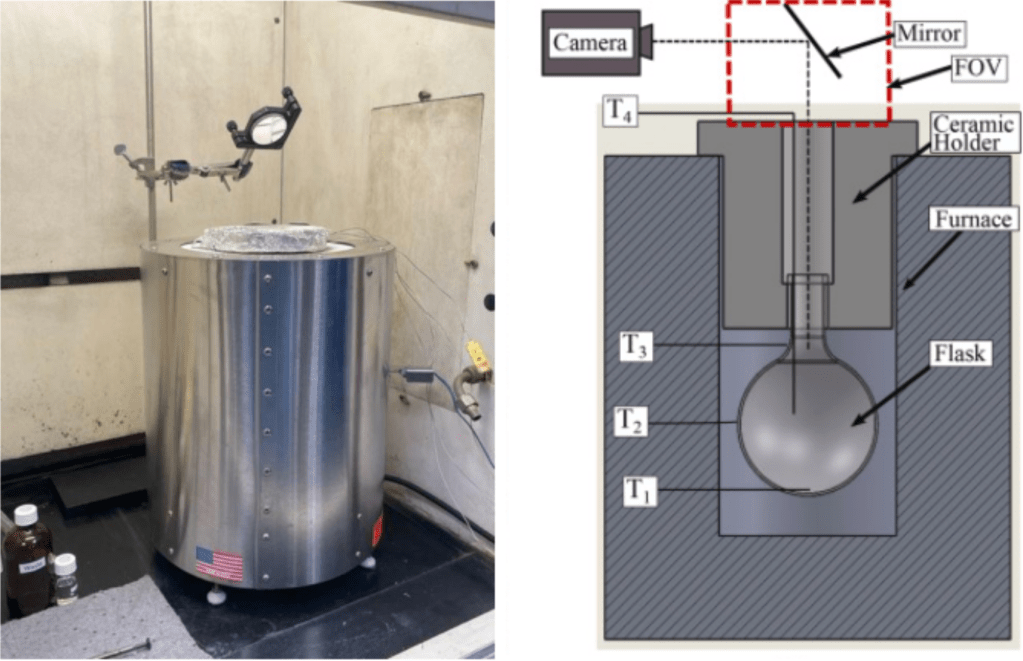
A Phantom VR3746 high-speed camera and mirror were used to record the flame, as displayed above. In the case that the hydraulic fluid does not ignite within ten minutes, the experiment was ruled a non-ignition. To clean the flask of the gaseous combustion products, a blow dryer was used. To clean the flask of soot or unburnt reactants, the furnace was set to 600℃ for 1-2 hours. Cases of non-ignition particularly required this sort of cleaning.
Results
The Cantera TBP combustion simulation predicted that HOPO2 (metaphosphoric acid) and PO(OH)3 (phosphoric acid) have a directly inverse relationship. The highest concentration of HOPO2 and lowest of PO(OH)3 occurred at φ = 1. The simulation modeled the major product species of hydraulic fluid combustion, including phosphoric acid and pyrophosphoric acid. The computed flame temperatures peaked at an equivalence ratio of 1.

Figure 2 predicts how the φ (equivalence ratio of the fuel) affects the composition of the TBP combustion products. H2O and CO2 were consistently produced at all equivalence ratios. Methane (CH4) was produced by particularly rich mixtures.
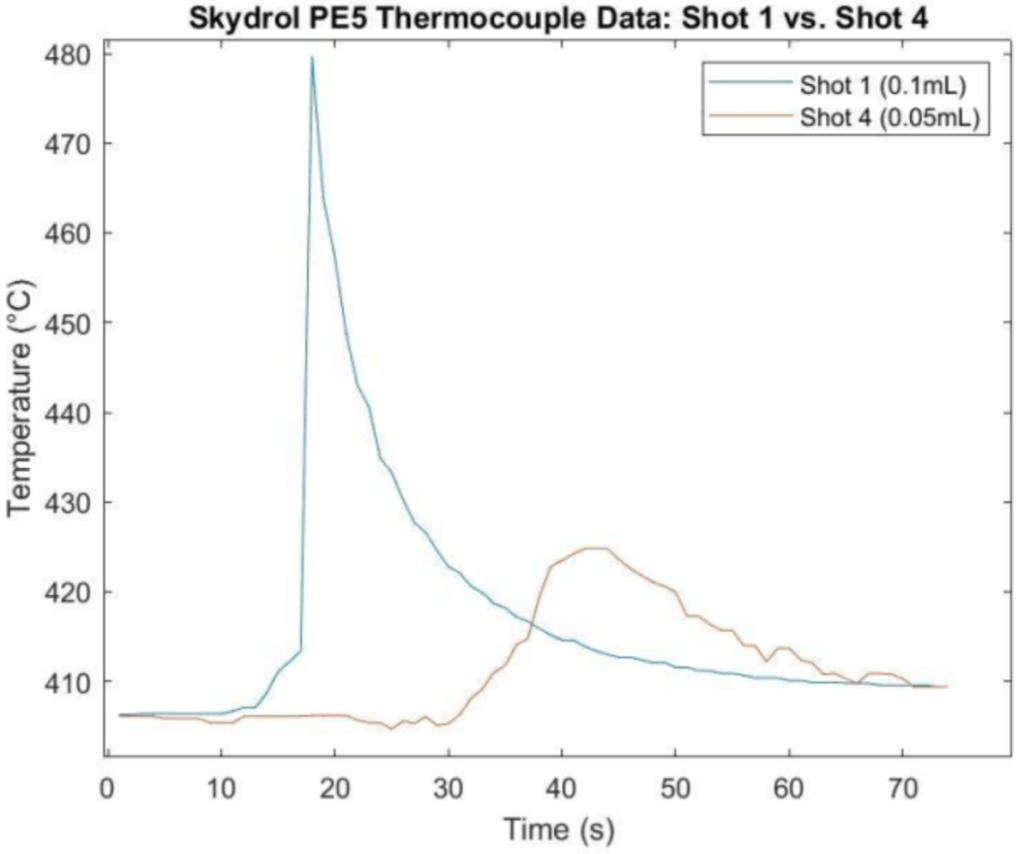
Figure 3 demonstrates how the φ of the fuel significantly impacts its ignition, with Shot 1, the rich PE-5 mixture, having a complete ignition while Shot 4, the lean PE-5 mixture, had only a rapid reaction. The initial flask temperature also directly impacts Skydrol PE-5 ignition, with lower initial temperatures causing longer ignition time delays and lower flame temperatures.

The differences in Figures 4a and 4b show how rich mixtures (Figure 4a) can ignite much more easily at lower temperatures than lean mixtures (Figure 4b). The correlation between initial temperature and time delay can also be corroborated by Figure 4, illustrating that the temperature rise becomes more gradual as the initial flask temperature decreases.
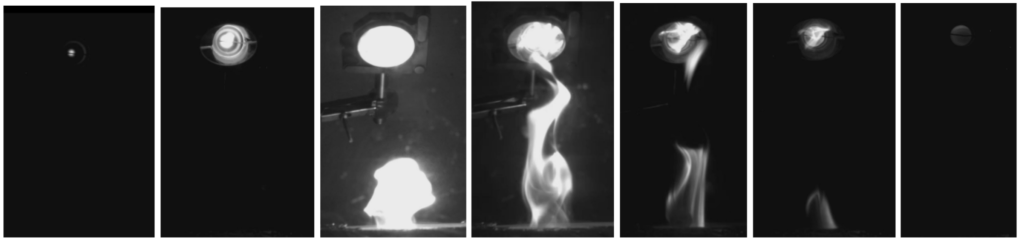
One result found was that not cleaning the flask properly made several of the first ignition tests inaccurate, and thus they cannot be analyzed. Combustion products (soot) coated the flask after each flame test, making the inside of the flask change from clear to black within three tests.
Discussion
One primary error in several of the first tests conducted was not predicting the significant interference of hydraulic fluid combustion products in ignition tests conducted afterwards. In previous EDL autoignition experiments, fuels such as n-hexane burned more cleanly. Due to the phosphorus present in the hydraulic fluids, these ignition tests resulted in heavy, phosphorus-containing products that dirtied the flask more easily.
Early data demonstrated that the flask was not sufficiently cleaned in between tests, as for example, both Skydrol PE-5 Tests 5 and 6 were conducted with 0.1 mL of fuel at approximately 417°C, but differed. Test 5 fully ignited, while Test 6 had no flame at all.
The results of the thermocouple data, along with the Cantera calculations, suggest that phosphoric acid and pyrophosphoric acid were produced by the hydraulic fluid autoignition and were the cause of interference in earlier tests, as they can act as large heat sinks. These and other partially decomposed species can also continue outgassing or vaporizing over long-time scales which is problematic for ignition tests performed in quick succession. For future aviation hydraulic fluid autoignition tests, the flask should be cleared of any gaseous products with a blow dryer after each test, and be cleaned in between every few tests by setting the furnace to 600°C for 1 hour to prevent soot from accumulating and interfering with combustion tests.
Figures 3 and 4 indicate that richer mixtures of the hydraulic fluid can autoignite through a much broader spectrum of temperatures than leaner mixtures, with the rich mixtures supporting Type 1 and Type 3 reactions down to 400°C while lean mixtures supported these reactions down to 440°C. Autoignition experimentation with Jet A fuel (POSF-4658) demonstrates a similar trend, with non-ignition occurring at higher temperatures for lean mixtures [4].
Conclusions
Autoignition still needs to be well understood to better improve industrial fire safety standards, especially in the case of aviation hydraulic fluids, which are known to be fire-resistant but are still capable of autoignition. To better understand the nature of their ignition, we used Cantera to compute the combustion products of phosphate ester hydraulic fluids and conducted ASTM-E659 tests with Skydrol LD-4 and Skydrol PE-5.
Future work with hydraulic fluid autoignition should consider the diligent cleaning of the flask being used, as in this study, combustion product interference proved to be a challenge. The dimensions of the syringe needle being used should also be considered, as using a needle with a smaller gauge inhibits proper intake of the fluid. Further work is needed to better model hydraulic fluid combustion and understand the autoignition of pure tributyl phosphate as a surrogate, as well as analyze the products of hydraulic fluid thermal decomposition.
Acknowledgments
I would like to extend my sincere thanks to the Caltech SURF program, the Explosion Dynamics Laboratory, and its funding agency, the Boeing Company. This project would not have been possible without their aid. Particularly helpful to me during this time were Dr. Joe Shepherd, who gave me the opportunity to work in his laboratory over this summer, and Conor Martin, who guided me along this project and gave me sufficient background to be able to complete it. Special thanks to Kevin and Susan Crook and the Student Faculty Programs Office at Caltech for helping fund and organize my SURF project, and allowing me the opportunity to engage in academic research as an undergraduate first-year.
References
[1] ASTM, E. (1896). 659-94. Standard test method for autoignition temperature of liquid chemicals. Annual Book of Standards.
[2] Barney, G. S., & Cooper, T. D. (1994) The Chemistry of Tributyl Phosphate at Elevated Temperatures in the Plutonium Finishing Plant Process Vessels, Westinghouse Hanford Company Report WHC-EP-0737.
[3] Blake, David. (1990). Flammability of Fire Resistant, Aircraft Hydraulic Fluid. https://www.fire.tc.faa.gov/pdf/tn90-19.pdf
[4] Martin, C. D., & Shepherd, J. E. (2021). Low temperature autoignition of jet A and surrogate jet fuel. Journal of Loss Prevention in the Process Industries. https://doi.org/10.1016/j.jlp.2021.104454
[5] Jayaweera, T M, et al. “Flame Inhibition by Phosphorus-Containing Compounds over a Range of Equivalence Ratios.” Flame Inhibition by Phosphorus-Containing Compounds over a Range of Equivalence Ratios (Conference) | OSTI.GOV, 17 Mar. 2004, https://www.osti.gov/servlets/purl/15013967.
 Caltech Undergraduate Research Journal